Trees
Common Terminology
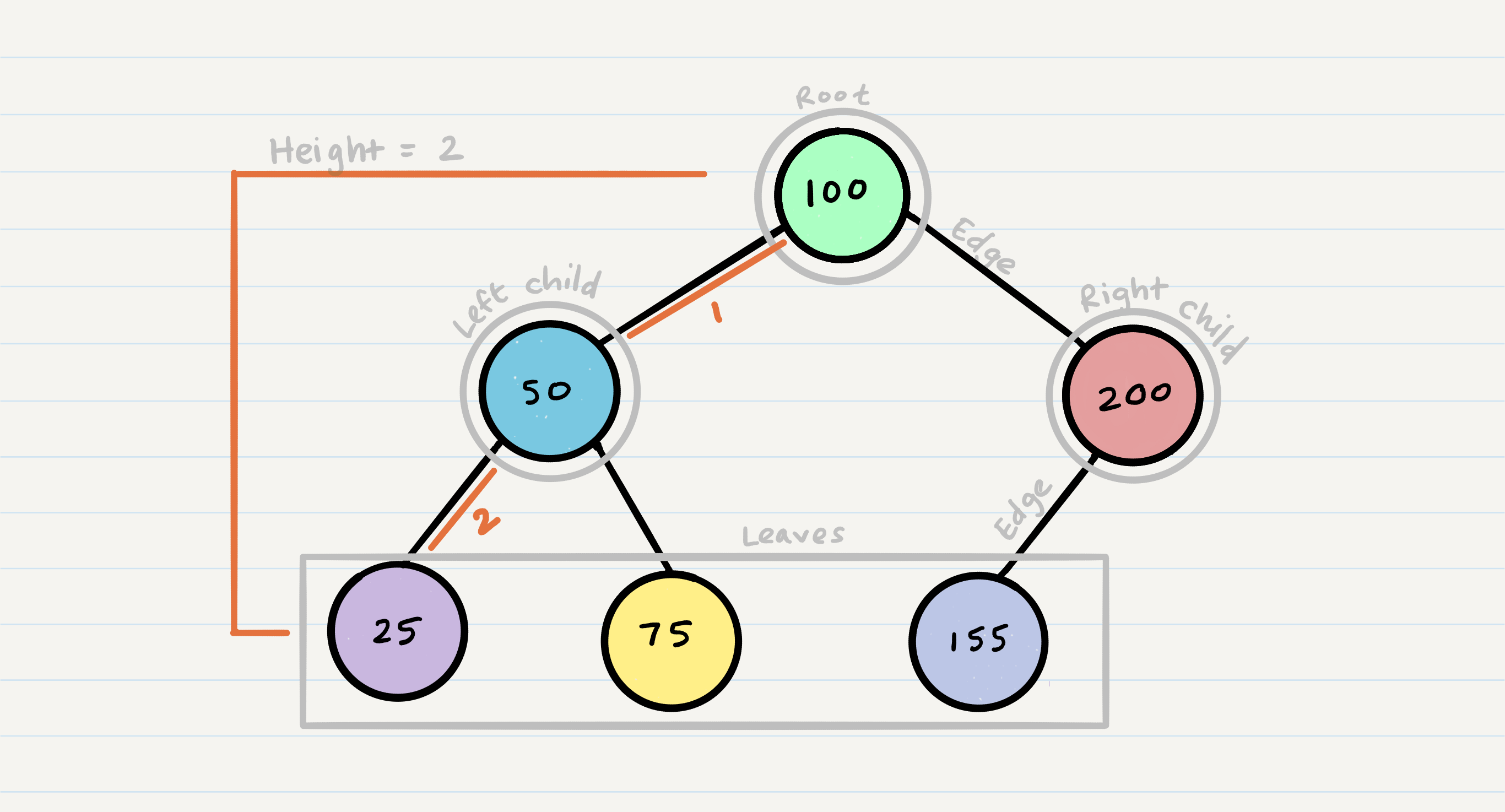
- Node - A Tree node is a component which may contain it’s own values, and references to other nodes
- Root - The root is the node at the beginning of the tree
- K - A number that specifies the maximum number of children any node may have in - a k-ary tree. In a binary tree, k = 2.
- Left - A reference to one child node, in a binary tree
- Right - A reference to the other child node, in a binary tree
- Edge - The edge in a tree is the link between a parent and child node
- Leaf - A leaf is a node that does not have any children
- Height - The height of a tree is the number of edges from the root to the furthest leaf
Traversals
Depth first
-
Depth first traversal is where we prioritize going through the depth (height) of the tree first. There are multiple ways to carry out depth first traversal, and each method changes the order in which we search/print the root
- methods for depth first traversal:
- Pre-order: A, B, D, E, C, F
- In-order: D, B, E, A, F, C
- Post-order: D, E, B, F, C, A
Breadth First :
Breadth first traversal iterates through the tree by going through each level of the tree node-by-node. So, given our starting tree one more time.
Binary Tree Vs K-ary Trees
- Binary Tree: Binary Trees restrict the number of children to two (hence our left and right children).
- K-ary Trees: Nodes are able have more than 2 child nodes
- Breadth First Traversal Traversing a K-ary tree requires a similar approach to the breadth first traversal. We are still pushing nodes into a queue, but we are now moving down a list of children of length k, instead of checking for the presence of a left and a right child.
- adding Node: One strategy for adding a new node to a binary tree is to fill all “child” spots from the top down. To do so, we would leverage the use of breadth first traversal. During the traversal, we find the first node that does not have all it’s children filled, and insert the new node as a child. We fill the child slots from left to righ
Big O
-
The Big O time complexity for inserting a new node is O(n). Searching for a specific node will also be O(n). Because of the lack of organizational structure in a Binary Tree, the worst case for most operations will involve traversing the entire tree. If we assume that a tree has n nodes, then in the worst case we will have to look at n items, hence the O(n) complexity.
-
Binary Search Trees : A Binary Search Tree (BST) is a type of tree that does have some structure attached to it. In a BST, nodes are organized in a manner where all values that are smaller than the root are placed to the left, and all values that are larger than the root are placed to the right.
-
Searching a BST : Searching a BST can be done quickly, because all you do is compare the node you are searching for against the root of the tree or sub-tree. If the value is smaller, you only traverse the left side. If the value is larger, you only traverse the right side.
- The Big O time complexity of a Binary Search Tree’s insertion and search operations is O(h), or O(height).
- Big O space complexity of a BST search would be O(1)